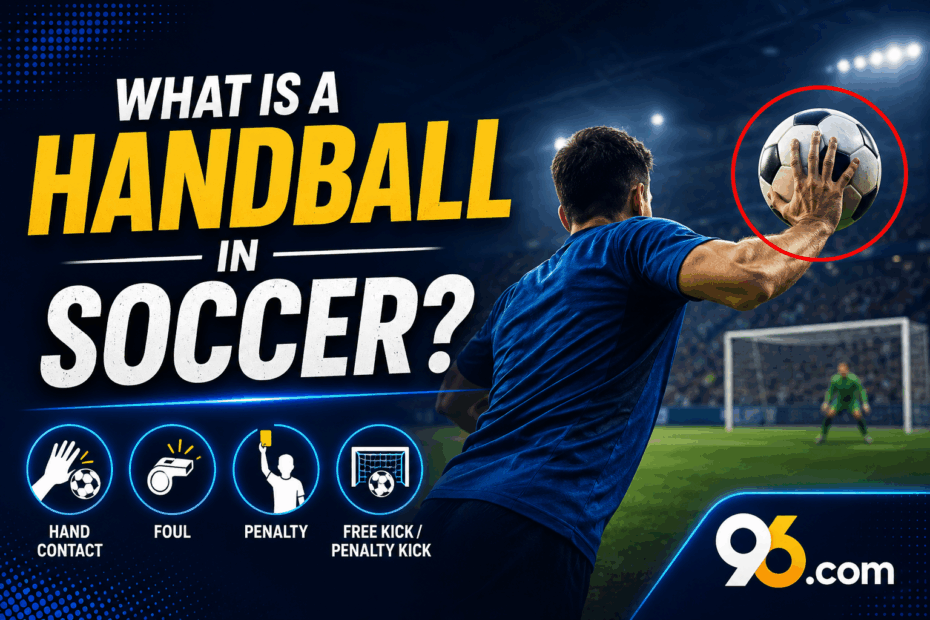
Today we will discuss one of the important topics in soccer. So let’s get started without wasting any time. Few things trigger more shouting in a stadium, or more chaotic debates on popular online soccer betting portals like 96 bet, than a referee blowing the whistle for a handball. For such a thrilling sport, the rules surrounding hand contact remain one of the most widely misunderstood concepts on the pitch.
At its most basic level, a handball happens when a player’s hand or arm makes illegal contact with the ball. However, the definition of the arm is completely bounded. As per the International Football Association Board (IFAB), the boundary for judging a handball is in line with the bottom of the armpit. Any contact from the shoulder down through the fingertips can potentially trigger an offense, provided specific optional criteria are met.
When Is a Handball Called in Soccer?
A handball is called when a player deliberately touches the ball or moves their arm to create an unnaturally bigger shape. Moreover, any goal scored directly off an attacker’s hand or arm, even if completely accidental, is instantly penalized.
Deliberate Hand Contact
The clearest version of such an offense is intentional movement. If a player moves their hand or arm toward the ball to move its trajectory, block a pass, or gain possession, the referee will immediately whistle for a foul.
A historic textbook example of this occurred during the 1986 World Cup quarter-final between Argentina and England. In the 51st minute, the legendary Diego Maradona leaped into the air against England’s 6-foot-1 goalkeeper, Peter Shilton. Knowing he couldn’t outjump him cleanly, Maradona used his left fist to punch the ball over Shilton and into the back of the net. The Tunisian referee missed it completely; the goal stood, and Maradona famously dubbed it the Hand of God goal.
Another legendary instance occurred in 2009, when France’s Thierry Henry deliberately handled the ball twice in the box to control it before crossing for William Gallas to score the winning goal against Ireland, booking France’s ticket to the 2010 World Cup.
Situations Where Play Continues
Not every touch is an infraction. If a player kicks or heads the ball and it immediately deflects onto their own arm, play carries on. Similarly, if a player is falling to the ground and the ball strikes their supporting arm, it is generally deemed accidental.
How Referees Decide a Handball
Referees evaluate body mechanics, distance, and intent before making a call. They determine if the arm’s position is a natural consequence of the player’s movement or if the defender took an unjustifiable risk to block the ball.
Position of the Arm
The physical placement of the arm is critical. If a player raises their arms above shoulder level or extends them laterally away from the torso, they instantly risk a whistle. Referees check if the arm position matches the athletic movement being executed.
Distance Between the Ball and the Player
Proximity dictates reaction time. If an opponent blasts a shot from two feet away and it strikes a defender’s arm, the referee will rarely penalize it due to the impossibility of reacting. Conversely, long-distance balls hitting an arm are heavily scrutinized.
Natural vs Unnatural Body Position
An unnatural position means the arm has made the body unnaturally bigger without justification from physical play. To help clarify how this fits into the broader rulebook alongside other defensive mechanics, here is how handballs contrast with legal defensive tasks:
| Action Type | Rulebook Definition | Match Impact |
| Legal Defending | Clean blocks, positioning, tackling, and answering What Do Defenders Do in Soccer? by protecting the zone without illegal arm extension. | Play continues seamlessly. |
| Handball Offense | Arm extended away from the body or above shoulders to block the ball illegally. | Disruption of play; free kick or penalty awarded. |
What Happens After a Handball Offense?
A penalized handball yields severe consequences. The opposing team receives a direct free kick or a penalty, depending on where the infraction occurred. The offending player may also face a booking or immediate dismissal depending on tactical disruption.
Direct Free Kick
If an outfield player handles the ball anywhere outside their own 18-yard box, the opposing side is awarded a direct free kick. This means the attacking team can shoot directly at the goal from the spot of the foul.
Penalty Kick
If a defender commits a handball infraction inside their own penalty box, it results in a penalty kick for the opposition. This drastically shifts the odds, turning a routine defensive sequence into a high-stakes, one-on-one showdown from 12 yards out.
Yellow and Red Card Situations
A handball isn’t just a physical foul; it can be a disciplinary disaster. If a player handles the ball to stop a promising attacking transition, they receive a yellow card. If they stop a certain goal on the line with their hand, it is a straight red card for denying an obvious goal-scoring opportunity.
The ultimate example of this occurred in the 2010 World Cup quarter-final between Uruguay and Ghana. In the final seconds of extra time, Ghana’s Dominic Adiyiah headed a shot that was absolutely flying into the back of the net. Former Uruguayan striker Luis Suárez channelled his inner goalkeeper and intentionally swatted the ball off the line with both hands. Suárez was shown a straight red card immediately. However, his tactical sacrifice paid off massively: Ghana’s Asamoah Gyan hit the resulting penalty against the crossbar, and Uruguay went on to win the match in a penalty shootout.
Can Goalkeepers Commit a Handball?
Goalkeepers enjoy specialized handling privileges, but those privileges are strictly bound by the boundaries of the penalty box. If a keeper handles the ball outside this marked territory, they are treated exactly like regular outfield players.
Inside Their Own Penalty Area
Within the 18-yard line, the goalkeeper can safely catch, punch, or hold the ball. However, they cannot use their hands if a teammate intentionally kicks the ball back to them via a deliberate backpass or throw-in.
Outside the Penalty Area
The moment a goalkeeper steps outside their designated penalty box, their handling immunity vanishes. If they touch the ball with their arm or hand even an inch past the line, a handball is called, often resulting in a direct free kick and a card.
Handball Situations That Often Confuse Fans
The fine margins of the rulebook keep fans guessing during tense match moments. A single deflection can completely alter whether an arm touch triggers a foul whistle, sending analysts and casual viewers into fierce debates.
Ball Deflecting Off Another Player
When the ball unexpectedly ricochets off a nearby opponent or teammate and strikes a player’s arm at point-blank range, it is usually deemed unpenalizable. The referee looks for an active, unnatural motion rather than an unavoidable physical collision.
Handball During an Attacking Move
The rulebook is fiercely strict on attacking players. If an attacker accidentally handles the ball and immediately scores, or if the touch directly sets up a goal-scoring opportunity for a teammate, the goal is disallowed. Accidental context offers no protection here.
Handball Inside the Penalty Box
When determining a penalty, the referee isolates the arm’s silhouette. If a defender is turning away but leaves their arm trailing wide, a penalty is given. The baseline rules for handling within the box are outlined below:
- Unnatural Silhouette: Arms extended outward or vertically above the head will trigger a penalty if struck.
- Body Deflections: Ball striking an arm directly after pinging off the player’s own head or foot is exempt.
- Support Arms: Landing on the turf with a stabilizing arm beneath the body will rarely be penalized.
How the Handball Rule Has Changed Over the Years
The rulebook has shifted dramatically from a simple baseline of intentional handling to highly technical, text-heavy modern criteria. The quest for absolute clarity has ironically kept the rule at the center of global sporting debate.
Recent IFAB Law Updates
Recent years saw IFAB walk back over-reactive rules that penalized every accidental attacking handball in the buildup. Now, only immediate goals scored via the hand or the immediate goalscorer’s accidental touch are overturned.
Why the Rule Is Still Debated
Despite video replays and strict text updates, human interpretation remains a massive factor. Deciding what constitutes a natural silhouette during an explosive, dynamic physical jump leaves an inherent gray area that keeps pundits talking.
Handball vs Other Soccer Fouls
To truly master the mechanics of the game, one must understand what constitutes a foul in soccer as a whole. While handling involves structural arm placement, other fouls concentrate on reckless physical contact, challenging safety limits, and mistimed defensive actions.
Handball vs Dangerous Play
Dangerous play involves an action, like a high boot near an opponent’s face, that threatens injury without making direct illegal physical contact. A handball, by contrast, is a tactical or spatial infraction involving the ball itself rather than an opponent’s safety.
Handball vs Tackling Fouls
Fans learning what are tackles in soccer understand that a legal challenge targets the ball cleanly. A mistimed step turns into a foul. The difference in impact is clear:
- What is tackle in soccer: An active attempt to dispossess an opponent using the feet.
- Handball: An illegal physical intervention using the upper limbs to manipulate the ball’s movement.
Soccer Analytics & Digital Trends
For modern fans tracking team formations or engaging in digital sports spaces, staying updated on rule nuances is essential. Platforms like 96 Bet provide detailed statistical break-downs of match events, helping enthusiasts analyze historical foul trends. Additionally, checking mobile sports platforms, such as downloading the official 96 APK, allows users to monitor real-time referee decisions and live match metrics during crucial league fixtures.
Conclusion
The handball rule bridges intent and physical mechanics. While intended to prevent unfair manipulation, its modern interpretation requires a careful look at body silhouettes and natural motion. Understanding these boundaries helps clear up the confusion, whether you are trying to understand Why Do Soccer Players Fake Injuries? after a soft box clearance, or simply tracking the game like an expert football betting analyst.
FAQs
Can a player score directly after the ball touches their hand?
No, any goal scored directly off an attacker’s hand or arm is immediately disallowed.
Does every handball result in a penalty?
No, it only results in a penalty if committed inside the defender’s own penalty area.
Why do referees sometimes ignore handball appeals?
They dismiss appeals if the arm was in a natural position or struck by an unavoidable deflection.
Can VAR overturn a handball decision?
Yes, VAR reviews objective handling errors leading directly to goals, penalties, or red cards.
Are handball rules the same in youth and professional soccer?
Yes, the foundational IFAB Laws of the Game govern both levels structurally worldwide.
