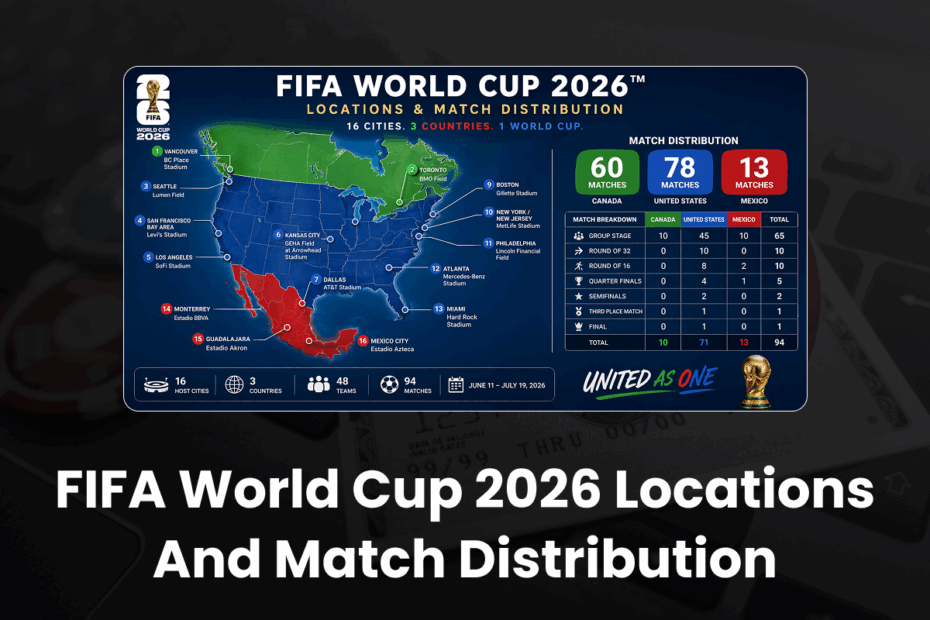
The FIFA World Cup 2026 is set to be the largest edition in history, featuring 48 teams and 104 matches. This expanded format moves away from the traditional 32-team setup to include more global representation. Players following football betting tips often look for location data to understand travel fatigue and stadium conditions. The tournament will span three nations, creating a unique challenge for teams and fans navigating North America.
For real-time updates and match odds, the 96 app serves as a vital tool for enthusiasts tracking every fixture across these vast distances.
Overview of World Cup 2026 Locations
The tournament will take place in 16 host cities across the United States, Canada, and Mexico. Eleven of these cities are located in the US, three in Mexico, and two in Canada. This geographic spread ensures that the FIFA World Cup 2026 game locations cover every major region of the continent. Most matches are scheduled for the US, including the final stages of the competition.
Countries Hosting Matches (USA, Canada, Mexico)
The host nations provide a mix of historic venues and ultra-modern stadiums to accommodate millions of global visitors. Each of the FIFA World Cup 2026 host countries has a distinct football culture and climate that will influence match play. Mexico makes history as the only three-time host, while Canada debuts as a men’s World Cup host. Users can check the 96 apk to see how regional home advantages impact the latest betting lines.
Total Host Cities and Venues
| Country | Host Cities | Number of Venues | Total Matches |
| USA | 11 | 11 | 78 |
| Mexico | 3 | 3 | 13 |
| Canada | 2 | 2 | 13 |
The total 104 matches are split to ensure maximum exposure for all three hosting nations. Each venue was selected based on its capacity to hold at least 45000 fans per game.
Match Distribution Format Explained
FIFA redesigned the format to include 12 groups of four teams each during the opening stage. This ensures that every team plays at least three matches before any potential knockout elimination occurs. The top two teams from each group, plus the eight best third-place teams, advance to the new Round of 32.
Also Read: Top FIFA World Cup 2026 Host Cities – What Fans Need to Know
How Matches Are Divided Across Countries
The US will host the lion’s share of matches, including all fixtures from the quarter-finals through the final. Canada and Mexico each host 13 matches, primarily focusing on the group stage and early knockout rounds. This distribution maximizes the usage of high-capacity American stadiums for the highest-profile games.
Group Stage Match Distribution
The group stage features 72 matches played over 16 days to keep the tournament momentum high. Each host nation is guaranteed to play its group stage matches on home soil to boost local engagement. Following the FIFA World Cup group stage 2026 updates is essential for players looking to spot early tournament trends.
- USA Groups: Focused on major hubs like Los Angeles, Dallas, and New York.
- Mexico Groups: Centered around the iconic Estadio Azteca and modern Monterrey venues.
- Canada Groups: Hosted in Toronto and Vancouver with a focus on multicultural fan bases.
Knockout Stage Match Allocation
The knockout stage introduces the Round of 32, adding an extra layer of excitement and unpredictability for fans. A total of 32 teams will compete in single-elimination matches to reach the final in New Jersey. Understanding the FIFA World Cup knockout matches 2026 path is crucial for long-term tournament predictions. Many players use the 96.com to track knockout brackets and potential matchups as the group stage concludes.
Which Cities Will Host Key Matches?
Key fixtures like the opening game and the final are strategically placed in historic or high-capacity cities. These FIFA World Cup 2026 key matches are expected to draw record-breaking television audiences worldwide. The selection of these cities reflects the tournament’s goal of blending tradition with modern infrastructure.
Opening Match Location
The tournament kicks off at the Estadio Azteca in Mexico City on June 11 2026. This legendary stadium is the first to host the opening match of three different World Cups. Mexico vs South Africa will be the inaugural fixture of this massive 48-team competition.
Semi-Finals and Final Venue
| Match | Venue | City | Date |
| Semi-Final 1 | AT&T Stadium | Dallas | July 14, 2026 |
| Semi-Final 2 | Mercedes-Benz Stadium | Atlanta | July 15, 2026 |
| Final | MetLife Stadium | East Rutherford | July 19, 2026 |
The FIFA World Cup 2026 final location at MetLife Stadium offers a capacity of over 82000 seats. This venue in the New York/New Jersey area was chosen for its global accessibility and massive fan capacity.
USA Cities and Match Distribution
The 11 US cities are the backbone of the tournament, hosting 75% of all matches played. Cities like Dallas and Los Angeles will host eight matches each, the most of any individual city. These FIFA World Cup 2026 US cities are equipped with NFL-standard stadiums that offer premium fan experiences.
Canada Cities and Match Allocation
Toronto and Vancouver represent Canada with seven and six matches, respectively, during the event. These FIFA World Cup 2026 Canada cities provide a coastal balance to the tournament’s North American footprint. Vancouver’s BC Place will host five group stage matches and two knockout round fixtures.
Mexico Cities and Match Allocation
Mexico City, Monterrey, and Guadalajara share the 13 matches allocated to the nation. Estadio Azteca hosts five matches, while the other two cities host four games each. These venues are known for their intense atmospheres, which often favor the home side in soccer betting markets.
Travel and Logistics for Fans
Navigating between host cities requires careful planning due to the massive distances involved. Fans following FIFA World Cup travel 2026 advice should book flights and accommodation well in advance. Cross-border travel between the three nations will be streamlined to assist the millions of expected visitors.
Time Zones and Match Scheduling Impact
Matches will take place across four different time zones, from Pacific to Eastern time. This variety ensures that FIFA World Cup match timings cater to different global television markets simultaneously. Players must account for these time shifts when placing live bets on the 96 app to avoid missing the kickoff.
Economic and Infrastructure Impact
Host cities expect a massive surge in local revenue from tourism, transport, and hospitality sectors. The FIFA World Cup impact in 2026 includes billions of dollars in stadium renovations and public transport upgrades. These investments leave a permanent legacy that benefits local sports communities for decades.
| Impact Area | Benefit Type | Projected Value |
| Tourism | Short-term spending | 3 Billion |
| Infrastructure | Long-term facility use | 1.5 Billion |
| Jobs | Temporary employment | 50000+ |
Conclusion: Locations & Match Distribution Summary
The 2026 World Cup distribution ensures a balanced experience across the United States, Canada, and Mexico. By utilizing 16 world-class cities, FIFA has created a platform for the most accessible tournament ever. This FIFA World Cup 2026 summary highlights the logistical scale required to host 48 teams and millions of fans. As the tournament approaches, users can rely on the 96 for the most accurate match data and venue insights.
