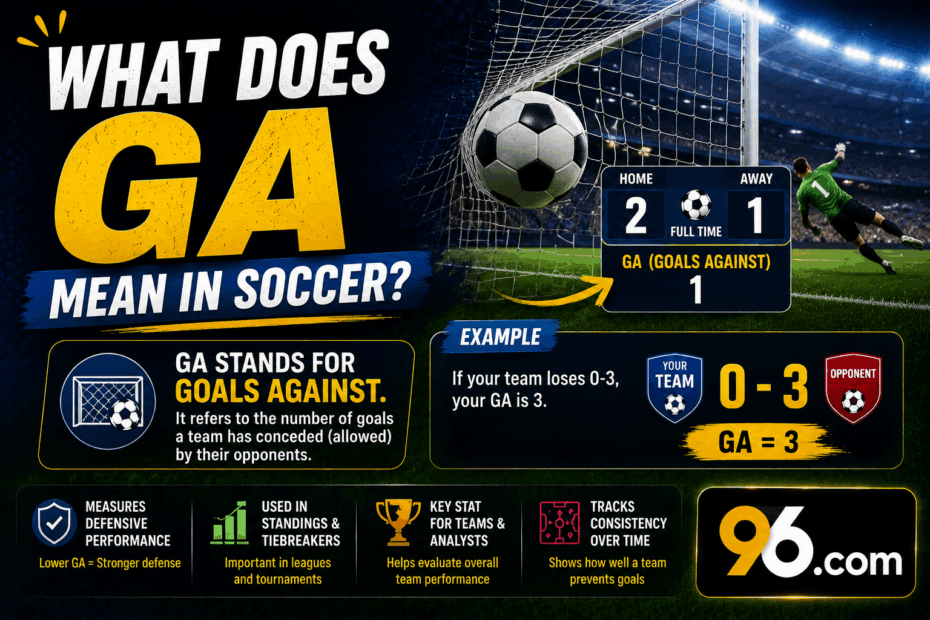
Hi football fans, we’re here with another exciting article. Today we’ll talk about GA in soccer. Let’s answer the question: What does GA stand for in soccer? In soccer terms, GA stands for ‘Goals Against’. On today’s blog on 96.com app we will understand what Goals Against is and how football betting works.
Breaking Down the Meaning of GA in Football
Now that we know what GA stands for, you might still be thinking: what does GA mean in soccer?
Goals Against (GA) is a statistic that indicates the number of goals a team has conceded during a match or tournament.
Why GA Appears in League Tables
In a league table, Goals Against (GA) appears in the table alongside two other metrics: GF (Goals For) and GD (Goal Difference).
What GA Tells You About a Soccer Team
A team’s GA is a straight indicator of how many goals they have conceded in a season. Along with this let us also understand what does full-time mean in soccer betting means and how it works.
Defensive Strength and Weakness
The GA of a team highlights various weaknesses and strengths of the team:
- A team can have a good GA but suffer from specific weaknesses that affect the team.
- A team’s defence can be weak, but the only reason their GA stays low is because of a good goalkeeper.
Teams With Low vs High GA Records
| Minimal Goals Against | Poor Goals Against Rate | |
| Characteristics | Teams who have let in fewer goals focus on being disciplined and being physically imposing. | Teams who have an expensive GA often have a weak defensive side, or they play a highly attacking game. |
| Example | The 2004-2005 Chelsea side managed by José Mourinho conceded only 15 goals across 38 matches in the Premier League season. | Some teams use a high GA as a deliberate choice. Teams that use the ‘Gung-Ho’ approach know that they will concede goals, but bet on the fact that they can score more. (Winning matches 4-3 or 3-2) |
Why Coaches Monitor GA Closely
Coaches pay close attention to how a team focuses on reducing the number of goals they let in; it also shows how good or bad a team’s defensive side is and if they need to improve.
GA, GF, and GD Explained Together
How many goals a team lets in, or scores, is important because they go hand in hand with goal difference.
The number of goals your team lets in becomes the (GA), and the amount you score in a season is your (GF).
Now, what is goal difference? It’s a simple number that can be either negative or positive, and you get it by subtracting Goals For and Goals Against.
Goals Against vs Goals For
If you get confused between these two, let us give you a simple example.
We use a lock and key to make sure no one breaks into our house, right?
So, in the same way, the number of goals your team has let in is your lock, because it’s something you don’t want to happen.
And the amount you score in a season is basically your key. This is because you’re trying to get to it.
Understanding Goal Difference Easily
If you’ve just started watching soccer, it can be difficult when you look at a table and think, what is a goal difference?
Goal Difference is the margin line which decides if your team will win or not. For example, if Arsenal and Manchester United are tied with the same points, the amount of goals they achieved, and let in are subtracted to find the goal difference.
Now, whoever has the bigger difference will get the higher rank on the table.
Which Stat Matters More in Tight Competitions?
Goal Difference matters the most because it becomes a tiebreaker when teams are stuck in the same place due to their points.
But it’s also said that maintaining a good GA can help your team a lot.
How GA Impacts Tournament Standings
In a tournament with elite teams, keeping a tight GA keeps your goal difference safe, and in case there’s a tie, the goals against percentage will boost your GD.
Title Races and Defensive Records
Having an inexpensive GA will almost always guarantee you something good. Because teams with a good GA almost always top the table and win the championship.
Relegation Battles and Poor GA Numbers
Teams that are at the bottom of the table usually have a sky-high rate of GA. It is possible that they could’ve scored a lot of goals, which means they’re an attacking team. But their defence is very weak, which leads to having a high GA.
For example, in the 2010/2011 season of the Premier League, Blackpool was managed by Ian Holloway. This team did not play defensively at all. They scored 55 goals; they also conceded an unbelievable 78 goals.
Clean Sheets and Their Effect on GA
When you maintain a clean sheet for at least one match, it keeps your GA from going up.
Real Examples of GA in Soccer Tables
These are some of the real-life examples from the 2025-26 Premier League and La Liga.
| Arsenal | FC Barcelona | Getafe |
| They let in only 27 goals in the entire season. | Barcelona also kept their numbers minimal with 36 goals across the tournament. | They finished 7th on the table, but conceded onlyb38 goals. |
Teams Known for Strong Defences
Teams such as Arsenal and Real Madrid are famous for keeping their GA numbers low. Their defence is very strong, which enables them to allow very few goals past them.
High-Scoring Teams With Weak GA Records
Did you know that it’s possible to score but have a poor goals against rate? This happens because a team can be very good at scoring, but their goalkeeper or other teammates might not be so good at saving the ball.
In this year’s La Liga Villarreal FC scored 72 goals, but also allowed 46 goals.
Quick Soccer Stat Guide
This breakdown will give you a quick look at the soccer stats:
GA Meaning
In soccer, GA stands for ‘Goals Against’. This is the number of goals your team concedes during a season. An inexpensive GA indicates that your team is good at defending, while a high GA suggests your team is lacking in various places.
GF Meaning
GF means ‘Goals For’; it is the number of goals your team scored during a tournament. It’s said that having a higher goal is better than having a high goal.
GD Meaning
GD stands for ‘Goal Difference’. Goal difference acts as a tiebreaker when two teams are tied at the same spot.
GD is calculated by subtracting Goals For from Goals Against.
Points System
The points system is divided into three tiers:
- You get 3 points for a win
- 1 point for a draw/tie
- And of course, 0 points for a loss
Conclusion:
Goals Against looks like a negative number, but in reality, it is what helps you win. Keeping a minimal GA is your best option. When you keep it minimal and have a good percentage of GF, it tells everyone that your team is elite and has some of the best players. Make sure to keep following 96 bet for football betting, rewards, and soccer betting-related information.
FAQs
What does GA stand for in soccer?
The full form of GA is Goals Against, and it’s a statistic used in the soccer league table.
What is the difference between GA and GF?
Goals Against is the number of goals your team concedes, and Goals For is the number of goals you score.
Is a lower GA better in football?
Yes, a minimal GA is good because it means your team has conceded fewer goals. And you have a strong defence.
How is GA calculated in soccer?
You don’t have to calculate the GA; it’s simply the number of goals a team and the goalkeeper concede.
Why is GA important in league standings?
The number of goals your team allows is important in the league standings because it affects the goal difference percentage. For example, Chelsea and Manchester City are tied for the same spot, and it turns out Chelsea let in fewer goals than Man City; Chelsea will take the upper spot.
