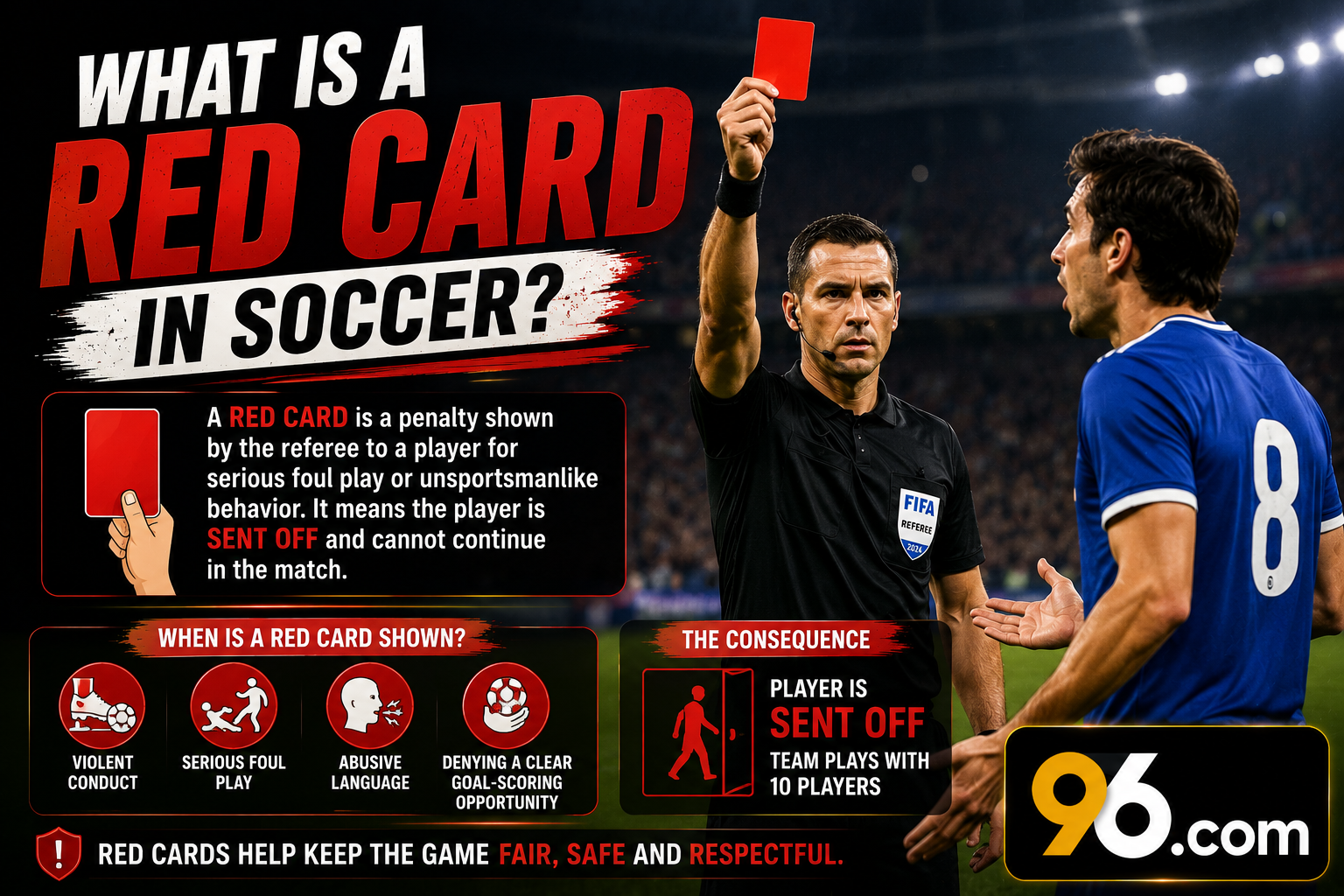
Hi, fellow football supporters, we’re here with another article. If you’ve watched football, you must’ve heard the question: What does red card mean in soccer? A red card indicates that a player has violated the rules of the game, either via their behaviour or physical actions. This blog on 96.com will explain what a red card is, along with the football betting tips and odds of the game.
What Happens When a Player Gets a Red Card?
Many consequences follow after a player receives a red card.
Immediate Sending Off Explained
Once a player gets a red card, they’re immediately sent off the field. They cannot continue playing, and neither can they be replaced by a substitute.
Why Teams Must Play With Fewer Players
Teams have to play with fewer players as a form of disciplinary action. It’s a fair rule for players who violate the opponent team; also, because football is a team sport, the entire team has to bear the consequences of the mistake.
Common Reasons Players Receive Red Cards
Players can receive red cards due to various actions. Along with such queries, we also understand: what does GA mean in soccer, and how does it work?
Serious Fouls and Dangerous Tackles
When players tackle others with a lot of force, or in a way that could hurt the opponent, it’s dangerous and becomes a foul.
Violent Conduct and Fighting
- Punching
- Kicking
- Headbutting
- Spitting
All these are considered to be violent conduct.
Also, when players engage in a fight, it immediately results in a minimum three-match ban, which can be extended.
Denying a Clear Goal-Scoring Chance
If someone intentionally tries to stop the opposing player from scoring on a clear shot, it is considered a foul.
Receiving Two Yellow Cards
If you get a second yellow card during the match, it’s counted as a red card, and you’re sent off the field.
How a Red Card Changes the Match
Because the player cannot be substituted, the teams have to adjust to playing with one less player and change their plans accordingly.
Defensive Adjustments After a Sending Off
Man-mark the team’s main gap and limit the opponent’s space where a ball could be passed through easily.
Formations like these are usually used:
- 4-4-1
- 5-3-1
- 4-3-2
Psychological Pressure on the Team
When a teammate gets a red card, the remaining teammates panic or overthink and try to play a perfect game, but they can also end up making mistakes.
Impact on Match Results and Momentum
When a player gets a red card, the chances of their team winning drop significantly.
The opposition gets an edge over the other team, as they can make use of the situation.
But sometimes, though rarely, the team that is one player down due to the red card stands together instead of losing their morale and does their best.
Red Card Rules in Different Soccer Competitions
Different leagues have different regulations regarding red cards.
League Matches vs Tournament Games
In a league match, the suspension only lasts for one match.
But in a knockout format, the suspension can ruin the team’s hard work.
Suspension Rules After a Red Card
- If it’s a straight red card, the player is banned for three matches.
- If the red card is a result of two yellow cards, the player has to sit out only one match.
VAR Reviews and Modern Decision-Making
The video assistant is used only when the on-field referee makes a mistake or misses an incident that warrants a red card.
Also, VAR can recommend that the referee review the footage, but the final decision rests with the on-field official.
Famous Red Card Incidents in Soccer History
There are many famous red card incidents.
David Beckham in the 1998 round of 16 flicked his heel at Diego Simeone after a foul and was sent off. The match was against Argentina, and England eventually lost.
High-Profile World Cup Red Cards
In the 2006 World Cup final against Italy, Zinedine Zidane, a French legend, received a straight red card in extra time after headbutting Italy’s Marco Materazzi.
Controversial Referee Decisions
In the 2014 Premier League season, during Arsenal vs Chelsea, Kieron Gibbs received a red card after Alex Oxlade-Chamberlain handled the ball on the goal line. Despite protests from fans, Gibbs was sent off.
Yellow Card vs Red Card Explained Simply
This is the difference between a red card and a yellow card.
Main Differences Between the Two
- A yellow card is an official warning for breaking the rules.
- A red card requires the player to leave the field immediately and sit out for a few matches.
When a Yellow Turns Into a Red
If a player receives a second yellow card after the first warning, it’s automatically considered a red card.
What Players Can Learn From Red Card Situations
There’s a lot to learn from these situations to ensure this behaviour doesn’t occur in future matches.
Importance of Discipline
When a player gets the card, it’s not just them who are affected; their entire team suffers too. It puts teammates under physical and mental pressure and exhausts them, as the suspension can last for multiple matches.
Controlling Emotions During Matches
If you’re a player, you have to learn to let go if anyone angers you or the referee makes a bad decision. Instead, channel that energy into the game and make good decisions.
Tackling Safely Under Pressure
When players are tired or under pressure, they should focus on timing their moves rather than diving in unquestioningly. Learning to differentiate between when a yellow card risk is warranted and when a foul might result in a serious injury and a red is very important.
Conclusion
A red card is not just a disciplinary action for an individual player. It’s an action that actively affects everyone in the team. Managers have to change plans; the remaining 10 teammates have to adjust and make up for the missing player, which often leaves them exhausted. It’s better to stay cool and collected even when it’s tough.
Keep following 96 bet for more soccer betting and odds information, soccer betting, and rewards.
FAQs
What does a red card mean in soccer?
A red card is issued when a player engages in dangerous play or an action that can change the outcome of the game—for example, denying the opponent a clear shot at an obvious goal.
How many games does a player miss after a red card?
After a straight red card, a player misses multiple matches.
Can a red card decision be overturned?
The decision can be overturned if the league uses VAR and the on-field referee reviews the footage.
After a match, clubs can also submit a formal application to the league’s governing body. If they find it was a wrongful dismissal, the card can be overturned.
What is the difference between a yellow card and a red card?
A yellow is a warning for your behaviour, while a red is a final decision that leads to the player being sent off the field.
Can a substitute receive a red card in soccer?
Yes, substitutes can receive a red card. But if the substitute gets a red card, the team can use another player.
