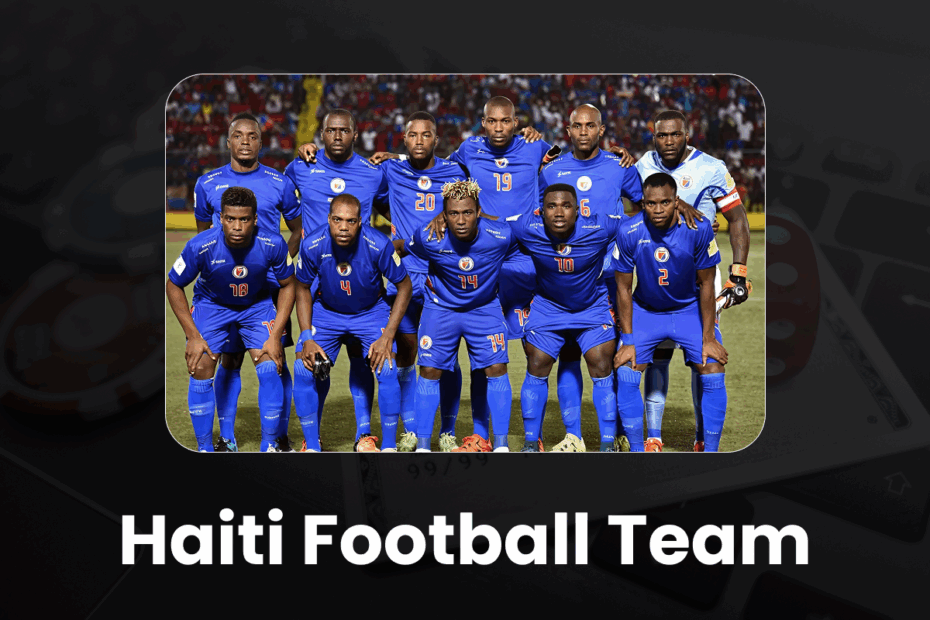
Yesterday it was Curacao, today it is Haiti. The 2026 World Cup will feature some truly surprising underdog nations. On a day that mixed joy with relief, Haiti’s men’s national team, Les Grenadiers, clinched a place at the FIFA World Cup with a disciplined 2-0 victory over Nicaragua on 19 November 2025. The win ended a 52-year World Cup drought; their previous appearance was in 1974 and provided a unifying moment for Haitians at home and in the diaspora.
The team’s road to the USA/Canada/Mexico was remarkable not only for results on the pitch but for the context of it, political instability, a collapsed domestic match environment, and extraordinary logistical hurdles.
In this blog on Odds96, we explain Haiti’s remarkable road to the FIFA World Cup 2026 and how they achieved qualification against all odds.
Success story of Haiti in football
Haiti’s last World Cup finals participation was in 1974; reaching 2026 will be only the second time in the nation’s history. That alone marks this qualification as historic.
The squad is largely made up of players based abroad, many in Europe and North America, who were recruited and assembled despite severe limits on domestic football infrastructure. The coach, Sébastien Migné, managed much of the campaign remotely and, because of security concerns, had not visited Haiti while leading the team.
In a country battered by gang violence, displacement and humanitarian crises, the qualification served as a rare national celebration and a symbol of resilience and unity. For many Haitians, it was an emotional, pride-filled respite from daily hardship.
Also Read: Pep Guardiola’s Coaching Tree: Who’s Doing What Now
How they performed in the CONCACAF qualification
The 84th FIFA side, Haiti, topped Group C of the CONCACAF final round with 11 points, with three wins, two draws and one loss, finishing ahead of Honduras and Costa Rica to claim direct qualification. Their key wins included the final-day victory over Nicaragua and a notable 1-0 win over Costa Rica in the run-up.
Across the final round, Haiti showed discipline at the back and relied on organised defending and compact lines. Goalkeeper and defensive displays in key matches, including a clean sheet in the decisive 2-0 game, were cornerstones of the campaign.
Louicius Don Deedson scored the opener in the Nicaragua match in the 9th minute and was an important attacking outlet during the campaign. He also scored the most four goals from them in this competition. Rúben Providence scored the second goal on 45+1 minutes, which guaranteed qualification and provided a defensive work rate.
Also Read: Best FIFA World Cup 2026 Hotels Near Match Stadiums
Fans Are Ecstatic, But Many Won’t Travel to the World Cup
1. Security & domestic instability
Haiti continues to face extreme security challenges. Reports in November 2025 described pervasive gang control in Port-au-Prince and widespread violence, which is why several international outlets noted that the team had to play ‘home’ qualifiers in Curaçao rather than in Haiti. These security realities make large-scale travel, mobilisation and safe domestic celebration more complicated.
2. Humanitarian & economic constraints
Beyond safety, Haiti is facing a deep humanitarian crisis with displacement, poverty and disrupted services. Many households lack the financial means, documents, or logistical capacity to travel internationally to the US/Canada/Mexico for match travel and accommodation costs, visa requirements, and time off work are all significant barriers. The Washington Post and AP coverage emphasise the scale of displacement and hardship that limits mobility.
3. Practical logistics (visa, cost, tickets)
The 2026 World Cup matches will be hosted across three countries (the US, Canada, and Mexico). Even when fans want to attend, visas, passport validity, ticket allocation systems and travel costs are realistic, often prohibitive obstacles for many Haitian supporters, especially while the country manages an acute humanitarian emergency.
Conclusion
Haiti’s qualification is both a sporting triumph and a powerful national moment: it proves that, even amid a crisis, sport can create hope and international recognition. On the pitch, the team has shown tactical pragmatism, organisation, and the ability to convert limited chances, qualities that will be essential at the World Cup. Off the pitch, the challenge now is ensuring the players get the preparation, protection and support needed to compete on the global stage while the nation continues to confront serious security and humanitarian problems.
The road to 2026 will test whether this achievement can catalyse longer-term investment in Haitian football and whether international goodwill can translate into real help for the game and for the people.
FAQs
Q: When did Haiti qualify for the World Cup?
A: Haiti secured qualification on 19 November 2025 with a 2-0 win over Nicaragua.
Q: Who scored the goals in the decisive match?
A: Louicius Don Deedson (9′) and Rúben Providence (45+1′).
Q: Is this Haiti’s first World Cup?
A: No, Haiti previously appeared at the World Cup in 1974. The 2026 appearance will be the second in the nation’s history.
Q: Why were some Haitian home games played in Curaçao?
A: Due to severe security problems and instability in Haiti, the team used Curaçao as a base for home fixtures for safety and logistical reasons.

