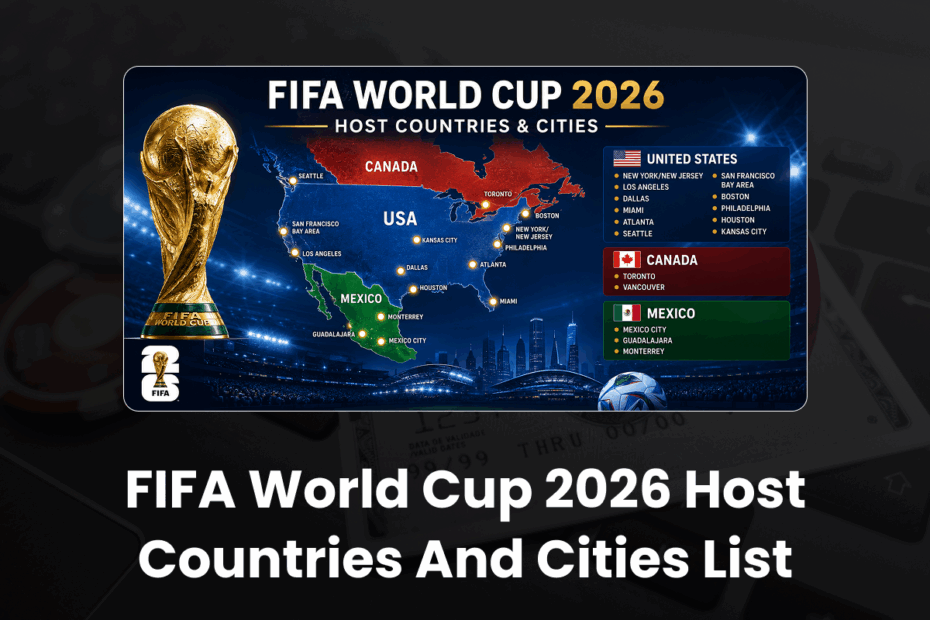
The FIFA World Cup 2026 is scheduled to run from June 11 to July 19, 2026, and it is the biggest edition of the tournament ever held. For the first time in history, three countries are co-hosting the event together: the United States, Canada, and Mexico. A total of 16 cities across these three nations will host 104 matches involving 48 teams, up from the 32 teams that competed in previous editions. If you are planning to follow the tournament closely on 96.com, knowing the host cities and their stadiums is the first thing you need to get right.
Introduction to FIFA World Cup 2026 Hosts
The 2026 World Cup is hosted across the USA, Canada, and Mexico, spanning 16 cities and featuring 104 matches.
Overview of Multi-Country Hosting
The 2026 World Cup marks the first time the men’s tournament is being shared between three countries. The United States has the largest share with 11 cities, while Mexico hosts 3 cities and Canada 2. With 104 total matches spread over 39 days, this is also the longest World Cup in the tournament’s history. All group-stage matches for each host nation will be played within their own borders. Canada becomes the first country to host the men’s World Cup for the very first time, making this tournament a landmark event for North American football.
Why This World Cup is Unique
No World Cup has ever been played across such a geographic area before. The host cities stretch from Vancouver on Canada’s west coast all the way to Miami in the south of the USA, covering multiple time zones and climate conditions. The tournament is also the first to use a 48-team format, which means 12 groups of four teams each will compete in the group stage. The two best teams from each group and the eight best third-placed teams will advance to a new Round of 32, creating a format that has never been used before at the World Cup level.
FIFA World Cup 2026 Host Countries
Three countries, the United States, Canada, and Mexico, are jointly hosting the FIFA World Cup 2026 for the first time.
United States as Primary Host
The United States is hosting 11 of the 16 venues and will stage all knockout-stage matches from the quarterfinals onward, including both semi-finals and the final itself. This is the second time the USA is hosting the men’s World Cup, having previously done so in 1994. The final will be held at MetLife Stadium in East Rutherford, New Jersey, near New York City, which has a capacity of 82,500. The semi-finals are assigned to AT&T Stadium in Dallas with a capacity of 94,000 and Mercedes-Benz Stadium in Atlanta with a capacity of 67,382.
Canada’s Role in Hosting
Canada is making its debut as a host nation for the men’s FIFA World Cup in 2026. Two cities are part of the hosting plan: Toronto and Vancouver. The opening match for Canada’s national team will be played at BMO Field in Toronto on June 12. Toronto’s BMO Field has a tournament capacity of 44,315, while Vancouver’s BC Place can hold up to 54,000 people. Canada previously hosted the FIFA Women’s World Cup in 2015, so the country has experience with large-scale FIFA events. All of Canada’s group-stage games will be played within the country.
Mexico’s Role in Hosting
Mexico is hosting the FIFA World Cup for the third time, making it the first country in history to do that. Its three host cities are Mexico City, Guadalajara, and Monterrey. The opening match of the entire tournament is scheduled for June 11, 2026, at the Estadio Azteca in Mexico City, where Mexico will face South Africa. Estadio Azteca will also become the first stadium ever to host matches in three separate men’s World Cups, having previously done so in 1970 and 1986. Mexico’s group-stage matches will all be held within Mexico.
FIFA World Cup 2026 Host Cities List
FIFA confirmed 16 host cities across the USA, Canada, and Mexico, selected from 23 candidate cities based on infrastructure and capacity.
Complete List of All Host Cities
FIFA confirmed all 16 host cities in June 2022. The full list covers Atlanta, Boston, Dallas, Guadalajara, Houston, Kansas City, Los Angeles, Mexico City, Miami, Monterrey, New York/New Jersey, Philadelphia, San Francisco Bay Area, Seattle, Toronto, and Vancouver. These cities were selected from a pool of 23 candidates based on stadium infrastructure, transport links, accommodation capacity, and broader logistical readiness. Washington, D.C., was among the cities that missed out due to the state of FedExField, the proposed venue.
USA Host Cities Breakdown
The 11 USA host cities are spread across the country to give the tournament national reach. New York/New Jersey hosts the final, Dallas and Atlanta host the semi-finals, while Los Angeles and Boston have been assigned quarter-finals. The remaining cities, Houston, Seattle, Philadelphia, San Francisco Bay Area, Miami, and Kansas City, are hosting group-stage matches. With the total number of matches in the USA at 78 out of 104, the country carries the bulk of the tournament’s workload.
| City | Stadium | Capacity | Key Match |
| New York/New Jersey | MetLife Stadium | 82,500 | Final |
| Dallas | AT&T Stadium | 94,000 | Semi-Final |
| Atlanta | Mercedes-Benz Stadium | 67,382 | Semi-Final |
| Los Angeles | SoFi Stadium | 70,000 | Quarter-Final |
| Boston | Gillette Stadium | 63,815 | Quarter-Final |
| Houston | NRG Stadium | 68,311 | Group Stage |
| Seattle | Lumen Field | 65,123 | Group Stage |
| Philadelphia | Lincoln Financial Field | 65,827 | Group Stage |
| San Francisco Bay Area | Levi’s Stadium | 71,000 | Group Stage |
| Miami | Hard Rock Stadium | 65,000 | Group Stage |
| Kansas City | Arrowhead Stadium | 73,000 | Group Stage |
Canada Host Cities Breakdown
Canada’s two host cities, Toronto and Vancouver, are located at opposite ends of the country. Toronto is in the east, and Vancouver is on the west coast, nearly 3,350 km apart. Both cities will host group-stage matches. BMO Field in Toronto has a capacity of 44,315, and BC Place in Vancouver holds up to 54,000 fans. These venues were selected for their existing infrastructure and strong football betting fanbases.
Mexico Host Cities Breakdown
Mexico’s three host cities are Mexico City, Guadalajara, and Monterrey. Mexico City’s Estadio Azteca, with a capacity of 72,766, hosts the opening match. Guadalajara’s Estadio Akron holds 44,330 people while Monterrey’s Estadio BBVA has a capacity of 50,113. Both Guadalajara and Mexico City sit at high altitude, which is a known factor that affects player performance and team selection during matches played there.
| Country | City | Stadium | Capacity |
| Canada | Toronto | BMO Field | 44,315 |
| Canada | Vancouver | BC Place | 54,000 |
| Mexico | Mexico City | Estadio Azteca | 72,766 |
| Mexico | Guadalajara | Estadio Akron | 44,330 |
| Mexico | Monterrey | Estadio BBVA | 50,113 |
Key Cities Hosting Major Matches
Certain host cities carry the biggest matches, from opening games in Mexico City to the World Cup Final at MetLife Stadium in New Jersey.
Cities Hosting Opening Match
The tournament’s opening match is set for June 11, 2026, at Estadio Azteca in Mexico City, where Mexico takes on South Africa. This is a historic choice as it marks Azteca’s third appearance in a men’s World Cup. Canada and the United States also play their opening group-stage games on June 12, with Canada at BMO Field in Toronto and the USA at SoFi Stadium in Inglewood, California. Each of the three host nations plays its group-stage matches entirely within its own country, which makes the opening fixtures especially meaningful.
Cities Hosting Knockout Matches
All knockout matches from the Round of 32 onward are staged in the United States. The quarter-finals are spread across multiple major US venues, including SoFi Stadium in Los Angeles and Gillette Stadium in Boston. The two semi-finals are locked in at AT&T Stadium in Dallas on one side and Mercedes-Benz Stadium in Atlanta on the other. The final is set for MetLife Stadium in New York/New Jersey on July 19, 2026. This structure ensures that the most-watched matches in the tournament are concentrated in the country with the largest stadiums and strongest broadcast infrastructure.
Final Match Host City
The 2026 World Cup final will be played at MetLife Stadium in East Rutherford, New Jersey, on July 19, 2026. The stadium has a tournament capacity of 82,500 and previously hosted the Copa America 2016 final. It is the home ground of both the New York Giants and the New York Jets of the NFL. FIFA officially confirmed MetLife as the final venue on February 4, 2024. The location near New York City gives the final an unmatched backdrop in terms of global media attention and fan interest from around the world.
Stadiums Across Host Cities
The 2026 World Cup uses 16 stadiums with a combined seating capacity exceeding 1.1 million, ranging from 44,315 to 94,000 seats.
Major Stadiums by Country
Across all 16 venues, the largest stadium in the tournament is AT&T Stadium in Dallas with a capacity of 94,000. Mexico City’s Estadio Azteca follows with 72,766, while MetLife Stadium in New York/New Jersey has a capacity of 82,500. Many of the US venues are NFL stadiums that have been converted for football use, with FIFA requiring all artificial turf surfaces to be replaced with natural grass. Four venues — Atlanta, Dallas, Houston, and Vancouver — are indoor or retractable-roof stadiums with climate control, which gives those venues an advantage during summer heat.
Capacity and Facilities
Stadium capacities for the 2026 World Cup range from 44,315 at BMO Field in Toronto to 94,000 at AT&T Stadium in Dallas. The combined seating across all 16 venues runs into more than 1.1 million seats. Several stadiums are being renovated ahead of the tournament, including Gillette Stadium in Boston. FIFA also requires all venues to meet specific broadcast, hospitality, and security standards before they are cleared for World Cup use. The natural grass installation project is being managed jointly by research teams from the University of Tennessee and Michigan State University.
Match Distribution Across Cities
All 104 matches are spread across 16 cities, with the USA hosting 78 games and Mexico and Canada each hosting 13 matches.
Number of Matches Per City
The total 104 matches are divided across 16 cities, with the USA hosting 78 matches, and Mexico and Canada hosting 13 each. Among the US cities, MetLife Stadium in New York/New Jersey is scheduled to host the most games due to its role as the final venue. Dallas’s AT&T Stadium is also hosting 9 matches, including a semi-final. FIFA designed the schedule to give each host city a meaningful number of games while managing the travel burden for teams that move between group-stage venues in their home country.
| Country | No. of Matches | Opening Match | Top Stage Hosted |
| USA | 78 | June 12 – SoFi | Final, Semis, QF |
| Mexico | 13 | June 11 – Azteca | Group Stage |
| Canada | 13 | June 12 – BMO | Group Stage |
High-Profile Match Locations
Beyond the final and semi-finals, several high-profile group-stage matchups are already assigned to specific cities based on team draws. Mexico City is particularly notable because Estadio Azteca hosts Mexico’s group-stage matches as well as the opening game. SoFi Stadium in Los Angeles is hosting a quarter-final, making it the biggest match of the tournament on the US West Coast. AT&T Stadium in Dallas, at 94,000 capacity, is one of the most anticipated match venues given its sheer size and the electric atmosphere that NFL games have already created there.
Travel Between Host Cities
Host cities are spread thousands of kilometres apart, so fans attending multiple matches need to plan flights and accommodation well in advance.
Distance and Connectivity
Given the scale of this World Cup, travelling between host cities is a significant planning concern for fans and teams alike. The distance between Toronto and Vancouver alone is around 3,350 km. Mexico City to Guadalajara is approximately 475 km, manageable by a one-hour flight. In the USA, the New York to Dallas route covers about 2,200 km and requires around 3.5 hours by air. Direct flights connect most host cities, and US airports in particular have high-frequency services on these routes. Fans planning multi-city itineraries should book accommodation well in advance, given the high demand across all host cities from June to July 2026.
Fan Travel Planning Tips
Fans travelling between host cities during the World Cup should keep a few things in mind. Book all flights and hotels early since prices will rise sharply as the tournament approaches. If you are attending matches in both the USA and Mexico, check visa requirements carefully because US and Mexican entry rules differ depending on your passport. For travel within Mexico between Guadalajara, Monterrey, and Mexico City, domestic flights are the fastest option. In the USA, cities like Los Angeles and San Francisco are close enough to combine into one trip. Carry local currency for Mexico in cash alongside your card since many smaller vendors outside stadiums may not accept digital payments.
| Route | Distance (km) | Flight Time | Best Option |
| New York to Dallas | approx.2,200 km | approx.3.5 hrs | Direct Flight |
| Los Angeles to San Francisco | approx.560 km | approx.1.5 hrs / 6 hrs drive | Flight or Drive |
| Mexico City to Guadalajara | approx.475 km | approx.1 hr flight | Flight |
| Toronto to Vancouver | approx.3,350 km | approx.5 hrs | Direct Flight |
| Dallas to Atlanta | approx.1,150 km | approx.2 hrs | Direct Flight |
Conclusion: FIFA World Cup 2026 Hosts Overview
The FIFA World Cup 2026 is a once-in-a-generation event that will take the sport across North America on an unprecedented scale. With 16 host cities, 104 matches, 48 teams, and three countries sharing the responsibility of hosting, this is genuinely the largest and most geographically spread World Cup ever held. The United States leads the effort with 11 venues and will stage all knockout matches, while Mexico brings historic weight with the Estadio Azteca hosting the opening game, and Canada steps into the men’s World Cup spotlight for the very first time. Whether you are planning to attend in person or follow from home, understanding the structure of the host countries and cities helps you make sense of the schedule and the tournament’s flow from first kick to final whistle.
