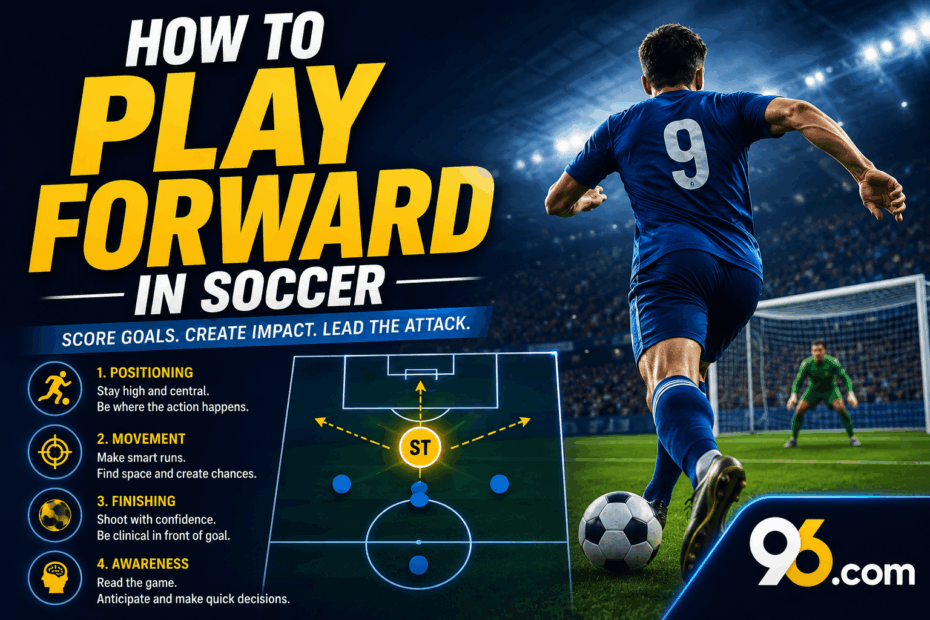
There is no rocket science behind this at all, like how to play forward in soccer. So let us get started on the topic without wasting any further time. Every top team needs a match-winning focal point to lead the line. Stepping into the final third requires raw confidence, tactical brains, and a direct approach. If you want to master how to play forward soccer and dominate the penalty area, you have to move with intent, refine your technical skills, and think two steps ahead of the backline.
For football analysts and those tracking performance trends on 96.com, understanding a forward’s movement profile is key. The top strikers dictate game lines, and smart soccer betting thrives on spotting which forwards can break low blocks and which get completely pocketed. Let’s look at the exact mechanics of leading the attack.
What Is the Role of a Forward?
A forward spearheads the team’s attack, bearing the primary responsibility for generating goals. By terrifying opposition center-backs, dragging defensive lines out of position, and converting tight half-chances, they dictate the tempo of the match and turn team possession into a real, lethal threat.
Creating Goal-Scoring Opportunities
Forwards are no longer static target men who wait for service. To unlock a tight defense, you must drop into midfield pockets, manipulate spaces, and pull markers out of position. Look at how Harry Kane drops deep to play split-passes, or how Kylian Mbappé drifts wide to pull full-backs out of shape. Dragging a center-back out of the defensive line tears open massive gaps that fast wingers and late-running midfielders can easily exploit. Successful attacking structures prioritize quick combinations and fluid rotations, ensuring that a defender never has a single point of focus to mark.
Leading the Team’s Attack
You are the outlet when your midfield regains possession. Your positioning determines how fast your team can transition from defense to attack by shielding the ball with your body, matching the physicality of imposing defenders, and making quick decisions. Physical monsters like Erling Haaland or Viktor Gyökeres excel here, forcing entire backlines to drop deep out of sheer fear. Your tactical awareness must be top-tier, especially in two-legged cup tournaments where understanding the scoreline is critical. Under high-stakes pressure, players must constantly ask: what is aggregate in soccer? It is the combined score of a two-legged knockout tie, meaning a forward must balance hunting goals with keeping possession to protect a lead.
Positioning Like a Good Forward
Elite forward play relies on spatial awareness rather than raw speed. Mastering how to move means operating as a ghost inside the box, ensuring defenders feel your presence but can never pin you down before you strike the ball home.
Staying on the Shoulder of the Defender
Standing where a center-back can see you is a rookie error. Instead, stay on their blind side. Modern masters of this craft like Lautaro Martínez position themselves just out of the immediate field of vision, forcing center-backs to turn their heads constantly. The moment the defender turns their gaze back to the ball, you have a split-second window to make an explosive movement in the opposite direction.
Making Timed Runs Into Space
Sometimes sprinting too early is useless. You must time your burst to match the playmaker’s release. Coordinate your acceleration with the body language of your passing midfielder. Strikers like Son Heung-min excel at waiting for the exact millisecond the passer shapes their body to strike the ball before starting their run. Curve your runs horizontally before cutting vertically to keep maximum speed while facing the target.
Avoiding the Offside Trap
It is never easy to beat the offside line; it requires discipline. Do not get caught staring at the ball. You must actively look down the line of the opposition’s back four, a skill that veteran forwards like Robert Lewandowski have perfected to ensure they stay level with or behind the second-to-last defender. Angling your chest toward the goal line allows you to react instantly without crossing the offside line before the ball is kicked.
Skills Every Forward Should Develop
To dominate the final third, you must back your movement with elite execution. Strikers need reliable physical tools, sharp control to shield the ball, clinical finishing, and the technical skill to link up with fast-charging midfielders under heavy, aggressive pressure.
Clinical Finishing
A forward must finish cleanly with both feet, their head, and off the volley. You must also understand the strict rules in the box to keep your goals on the board. For example, knowing what is a handball in soccer? is essential, as any ball hitting an attacker’s arm in the scoring phase, even accidentally, disallows the goal immediately.
| Player Name | Club | League Goals | Shots on Target % | Goal Conversion % |
| Harry Kane | Bayern Munich | 36 | 54.2% | 26.8% |
| Erling Haaland | Manchester City | 27 | 51.5% | 23.4% |
| Kylian Mbappé | Real Madrid | 25 | 49.8% | 20.1% |
First Touch Under Pressure
When a center-back is pushing your back, a poor first touch is a turnover. You must practice killing the ball with your chest, thighs, and both feet. Al Hilal striker like Karim Benzema built his career on this trait; receiving the ball on the back foot keeps your body between the defender and the ball, giving you the extra fraction of a second needed to look up, evaluate the target, and release a shot.
Dribbling in Tight Spaces
You will rarely get acres of space in the box. You must master close-control dribbling, keeping the ball close to your instep to navigate through tight defensive blocks. Players like Vinícius Júnior or Mohamed Salah utilize sudden body feints, drop their shoulders, and execute rapid changes of direction to throw defenders off balance without requiring immense physical space.
Passing and Link-Up Play
Modern forwards are not selfish islands; they are the connectors of the team’s attack. You must be highly capable of playing with your back to the goal. Look at how Ollie Watkins plays as a reliable link-man, executing crisp one-touch lay-offs to oncoming midfielders, holding up play under heavy physical contact, and delivering precise diagonal passes to overlapping wingers.
Different Types of Forwards
Tactical systems dictate how a striker operates on the pitch. Whether playing as a bruising target man or dropping deep to playmake, your designated archetype changes your zone of operation and your ultimate responsibilities during the attacking phase.
Center Forward
The traditional number 9 acts as the ultimate physical anchor inside the penalty box. They specialize in shielding long balls with their backs to goal, competing in brutal aerial duels, and converting close-range opportunities while operating strictly between the width of the opposition goalposts. Elite modern examples include Erling Haaland, Harry Kane, and Robert Lewandowski, who dominate center-backs in these central zones.
Second Striker
Operating right in the pockets behind a main target man, the second striker is a dynamic creator-finisher. They read game transitions fast, feeding off second balls, exploiting gaps created by the primary striker, and making late, unmarked charges straight into the heart of the box. Master tacticians like Antoine Griezmann, Paulo Dybala, and Thomas Müller excel in this specialized role.
False 9
The False 9 is a technical playmaker who starts up front and intentionally drops deep into central midfield. This pull disorganizes defenses: if a center-back follows them out, massive gaps open for wingers; if defenders stay, the False 9 has total freedom to turn and create. Forward-thinking managers regularly deploy players such as Lionel Messi (who popularized the role), Phil Foden, and Kai Havertz to manipulate defensive lines in this way.
How to Score More Goals as a Forward
Consistent goalscoring is pure science, not luck. To regularly find the net, you must master the geometry of the box, read the keeper’s positioning instantly, and use smart decoy movements to create a yard of space to shoot under pressure.
Choosing the Right Shooting Technique
You must evaluate the goalkeeper’s position in a split second. If the keeper is rushing out aggressively to close your angle, follow the example of Julian Alvarez and use a composed, low side-foot finish into the bottom corner. Reserve high-powered laces shots for situations where you must pierce through a crowded wall of defenders.
Attacking Crosses and Through Balls
To score from crosses, you must attack the ball with dynamic momentum rather than standing still. Read the body shape of your winger. Former Real Madrid striker Alvaro Morata is brilliant at making hard near-post runs to clip the ball before the goalkeeper can react, or peeling off to the back post to exploit isolated full-backs.
Creating Space Inside the Box
Inside the eighteen-yard box, space is a luxury. Use decoy movements to lose your marker. Take a page out of Dušan Vlahović’s playbook: sprint hard toward the goal line to force the entire defensive unit to retreat, then abruptly plant your foot, stop your momentum, and backpedal five yards to receive a clean cutback pass completely unmarked.
Common Mistakes New Forwards Make
Inexperienced forwards often kill their team’s offensive momentum with bad habits. Over-dribbling, standing still, and ignoring your basic defensive duties are easy ways to get pocketed by smart defenders and ultimately get hooked by your manager at halftime.
Holding the Ball Too Long
A common mistake is trying to beat too many defenders on your own. When you over-dribble, you allow the opposing defense to recover its shape. Young players should watch Marcus Thuram, who avoids this by releasing the ball in one or two touches when a teammate is in a better position, keeping the attack fluid.
Poor Movement Without the Ball
Standing completely still makes you incredibly easy to mark. Center-backs love playing against stationary forwards because they can easily track their position. You must copy the constant movement of elite attackers like Victor Osimhen, who is always shifting, checking, and altering his angles to keep the defense completely disorganized.
Ignoring Defensive Responsibilities
Modern football demands that defense starts from the front. If a forward refuses to press the opposing center-backs, the opponent can comfortably build up their attack. Strikers like Gabriel Jesus show the value of a high defensive work rate, actively pressing the back line to protect their midfield and keep the opposition under constant pressure.
Training Drills to Improve as a Forward
To transform clinical mechanics into instinct, your training ground routine must be elite. Running game-realistic drills that simulate tight spaces, high physical pressure, and rapid defensive recovery will prepare you to make clean decisions on match day.
Finishing Drills
Incorporate drills where you must receive and finish the ball with a single touch under tight time limits. Practice shooting from various angles, handling bouncing crosses, and taking low driven passes from the wings. This conditions your brain to mimic clinical sharpshooters like Alexander Isak, remaining perfectly calm and precise in high-pressure match situations.
One-on-One Practice
Set up situations where you receive the ball with your back to a defender at the edge of the penalty box. Look at how Darwin Núñez uses raw power to roll his marker; practice using your physical strength to protect the ball, performing sharp drop-shoulder feints to turn, and instantly launching a clean shot before a secondary defender can arrive.
Speed and Agility Workouts
To consistently leave defenders in your wake, you must work on your explosive acceleration. You can use these two specific training pointers to maximize your explosive pace:
- Perform explosive 10-yard starts with resistance bands to build powerful fast-twitch muscle fibers, just like lightning-fast forwards like Lois Openda.
- Set up rapid, multi-directional cone drills to improve your footwork, balance, and directional changes inside crowded boxes.
Learning From Elite Forwards
Top strikers are masters of efficiency. By watching elite players, you see that ninety percent of their work is done off the ball, using clever spatial manipulation to outwit backlines and execute decisive actions inside the eighteen-yard penalty box area.
Movement Off the Ball
If you watch Man City star striker Erling Haaland, he spends a large portion of the game scanning the pitch. He does not run mindlessly. Instead, he identifies the weakest defender, watches for spaces between the center-backs, and conserves his energy to unleash explosive, devastating bursts of speed at the exact right moment.
Decision-Making in the Final Third
The best forwards possess immaculate decision-making under intense pressure. Bayern Munich’s attacker Harry Kane is a perfect textbook example; he is not purely selfish and understands when to shoot and when to make an extra pass. If a teammate is in a significantly better scoring position, sliding a simple pass to him ensures team success.
Conclusion
It is also important to keep in mind that what a forward does in soccer requires balancing technical skills with smart tactical movement. By fine-tuning your touch, timing your runs into space, and mimicking the traits of top players like Erling Haaland and Harry Kane, you become a constant threat to any backline. Focus on these fundamentals to elevate your game and dominate the pitch. Whether hitting the pitch yourself or analyzing forward data via the 96 APK, sharpening these concepts will completely change your match-day experience.
FAQs
What qualities make a great soccer forward?
A clinical finisher like Erling Haaland needs elite spatial awareness, physical strength, and rapid explosive acceleration to score.
How can I become a better goal scorer?
Follow Harry Kane’s example: anticipate deflections, practice one-touch finishing, and use double movements to lose tight markers in the box.
Do forwards need to help in defense?
Yes, modern systems require strikers like Gabriel Jesus to trigger the high press and block deep passing lanes.
Which position is best for a beginner who wants to score goals?
The classic center-forward role, as played by Robert Lewandowski, is best for beginners to focus strictly on basic box positioning.
How do professional forwards create space to score?
Star footballers like Cristiano Ronaldo use blind-side runs and sudden drop-shoulder feints to leave defenders tracking empty grass.
