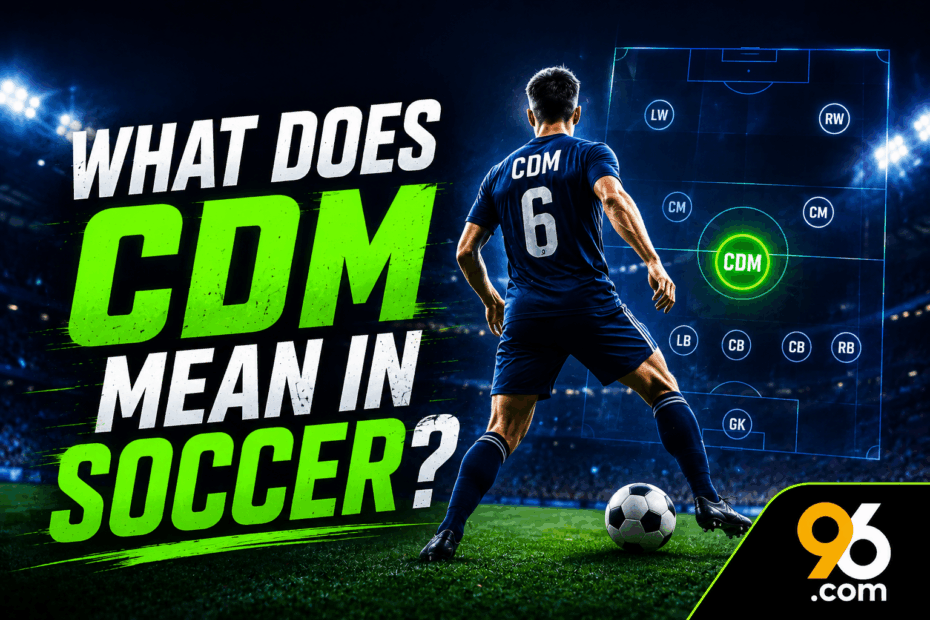
When exploring soccer betting markets or analyzing team sheets on 96.com, you will frequently encounter the term CDM. It is an acronym that carries massive tactical weight, serving as the literal anchor of a football team’s strategy. Without them, the entire system falls apart.
Understanding the CDM Position
The Central Defensive Midfielder (CDM) acts as a tactical shield, protecting the backline, breaking up opposition play, and dictating the tempo of the entire match from deep in the midfield.
Full Form of CDM
CDM stands for Central Defensive Midfielder, a vital role universally known as the holding midfielder or the traditional number 6. This structural position serves as the primary link between the defensive backline and the attacking engine, ensuring the team maintains possession while remaining fully protected against rapid opposition counters.
Where a CDM Plays on the Field
Operating in the crucial central corridor of the pitch, the defensive midfielder positions themselves right ahead of the central defenders and just underneath the box-to-box creators. They dominate the critical zone 14 territory outside their own penalty box, blocking off the direct passing lanes that creative opposition attackers desperately try to exploit.
Why Every Team Needs a Defensive Midfielder
Without a disciplined holding player, a team’s tactical system completely collapses under sustained pressure. The defensive midfielder stops fast breaks instantly, covers open space when attacking fullbacks sprint forward, and gives creative wingers the ultimate freedom to press high up the pitch, completely securing the defensive back door against unexpected turnovers.
What Does a CDM Actually Do During a Match?
A defensive midfielder operates as the tactical engine room, constantly balancing physical destruction of opposition play with smart, progressive distribution to jumpstart a team’s transitional phase.
Breaking Up Opposition Attacks
The primary mission of any elite defensive midfielder is to disrupt the opponent’s attacking rhythm constantly. They scan the field to read passing lanes, apply aggressive physical pressure to creative playmakers, and execute perfectly timed tackles to win back possession cleanly before the ball ever enters the penalty box.
Protecting the Center Backs
To fully grasp the defensive midfielder’s workload, one must understand what is a center back in soccer. Center backs form the final line of central defense before the goalkeeper. The CDM serves as their frontline shield, absorbing pressure so the center-backs are never dragged out of position to challenge oncoming attackers.
Starting Attacks From Deep Areas
Modern football demands that a holding player do much more than simply destroy opposition sequences. Once they successfully recapture the ball, they use composure and technical vision to spot open space, instantly breaking the opponent’s pressing traps with precise short ground passes or sweeping, long-range diagonal balls out to the flying wingers.
Skills That Make a Great CDM
An elite defensive midfielder requires a unique hybrid profile, combining the raw, physical combativeness of a defender with the vision, technical balance, and composure of an advanced playmaker.
Tackling and Interceptions
A top-tier holding midfielder reads the game multiple steps ahead of the unfolding play. Instead of diving into high-risk, reckless challenges, they master clean standing tackles. Furthermore, they excel at timing interceptions perfectly, using elite spatial positioning to steal the ball away smoothly without ever conceding dangerous set-piece opportunities.
Passing Under Pressure
Opposing managers regularly instruct their forwards to deploy aggressive pressing traps against deep midfielders to force high-turnover goals. Therefore, a modern defensive midfielder must possess incredible composure and a reliable passing range, turning away from heavy contact to deliver crisp, accurate first-time passes while tightly marked by defenders.
Positioning and Game Awareness
Physical stamina is secondary to elite cognitive processing and mental sharpness in the defensive midfield spot. Legendary coaches frequently note that the best anchors cover the ground with their minds. They constantly perform blind-side shoulder checks, calculate spatial distances, and instinctively know when to drop deep or squeeze the lines higher.
Leadership and Communication
Sitting at the absolute heart of the pitch, the holding midfielder enjoys a complete 360-degree view of the unfolding match. They act as the manager’s on-field general, shouting organizational instructions, initiating specific pressing triggers, and directing the defensive block to make sure no teammate accidentally loses track of their designated marking assignments.
CDM vs Other Defensive Positions
While modern defensive roles often blur and overlap during fluid phases of play, distinct differences in positioning, spatial duties, and tactical priorities separate them.
| Position | Primary Spatial Area | Main Responsibility |
| CDM (Defensive Midfielder) | Midfield third, right above the penalty box | Shielding the backline, intercepting passes, starting deep transitions |
| Center Back (CB) | Defensive third, directly inside/front of box | Making last-ditch blocks, winning aerial duels, clearing lines |
| Central Midfielder (CM) | Central third, box-to-box transition zones | Linking defense to attack, maintaining possession, and box entries |
CDM vs Center Back
If you are wondering how center back in soccer compares to a holding midfielder, the difference lies in the ultimate safety net. Center backs form the final physical wall inside the box. A defensive midfielder plays higher up the pitch, aiming to neutralize threats before they reach the final defensive area.
CDM vs Central Midfielder
A traditional central midfielder operates with a fully balanced, neutral profile, moving dynamically across the pitch. While standard central midfielders split their energy evenly between high-pressing attacking phases and defensive recovery tracking, a dedicated defensive midfielder prioritizes structural positioning and strict defensive coverage above everything else during a match.
CDM vs Box-to-Box Midfielder
The classic box-to-box midfielder is defined by an absolute engine of endless stamina, sprinting tirelessly from their own penalty box directly into the opponent’s area. Conversely, the holding midfielder must remain completely disciplined, rarely abandoning their deep central station to join attacks, keeping the structural counter-defense balanced at all times.
Famous CDMs Who Changed the Game
The evolution of the defensive midfield position can be mapped through iconic players who redefined how teams handle transitions and protect their defensive structures.
Legendary Defensive Midfielders
Claude Makélélé famously defined the solo anchoring role so comprehensively that the deep position in a 4-3-3 is universally referred to as The Makélélé Role. Similarly, Sergio Busquets revolutionized modern football at FC Barcelona, relying on flawless spatial intelligence, subtle body turns, and deceptive passing rather than pure physical brute force.
Modern CDMs to Watch
Manchester City’s Rodri stands as the undisputed gold standard of modern football, winning the Ballon d’Or due to historic passing metrics and peerless tactical reading. Alongside him, athletic engines like Arsenal’s Declan Rice and Real Madrid’s Aurélien Tchouaméni showcase the perfect blend of elite defensive destruction and progressive ball distribution.
Formations That Rely on a Strong CDM
A manager’s choice of tactical shape dictates exactly how the defensive midfielder will operate, whether holding the fort completely alone or sharing the structural workload.
4-3-3 Formation
In a classic 4-3-3 system, the holding midfielder serves as the sole pivot. This highly demanding setup requires the individual to cover massive lateral ground, single-handedly sweeping up danger across the pitch’s full width. At the same time, two advanced central midfielders push high into the half-spaces to support attacks.
4-2-3-1 Formation
The highly popular 4-2-3-1 formation utilizes a double-pivot engine room, deploying two deep-lying midfielders side by side. This dual-anchor system distributes the defensive workload evenly, frequently pairing an aggressive, ball-winning destroyer with a highly creative deep-lying playmaker to maximize possession retention and build smoothly from the backline.
Single Pivot vs Double Pivot
A single-pivot setup maximizes the number of attacking players available in advanced half-spaces but exposes the lone anchor to intense athletic exhaustion. Meanwhile, the double pivot provides premier structural stability and safe ball recycling, making it an incredibly popular baseline for analytical and risk-averse football betting strategies.
Can Any Player Become a CDM?
Transitioning into a defensive midfield role requires a total shift in mindset, prioritizing spatial discipline and positional awareness over individual attacking flair.
Training Tips for Beginners
Developing players must master the art of the continuous shoulder check to build a vivid mental map of the pitch before receiving the ball. Additionally, maintaining an open body orientation allows a player to see all fields of play, ensuring they can distribute the ball forward smoothly with their very first touch.
Common Mistakes New CDMs Make
The absolute most frequent error committed by young players is ball-watching. Beginners often chase the ball across the field like they did when discovering What Is Club Soccer? At the youth academy level. Deserting the central hub leaves the middle completely exposed, allowing intelligent opponents to slice through the team.
Developing Tactical Intelligence
To cultivate professional-grade tactical intelligence, players must look beyond the ball and actively study professional game footage. Aspiring midfielders should isolate elite professionals during off-ball phases, closely observing how they shift their weight, alter their running angles, and drop deep to fill open gaps across the backline.
Conclusion
From structural stability to launching rapid counter-attacks, the central defensive midfielder is the unsung hero of modern soccer. Whether you are analyzing matches for casual enjoyment or placing precise wagers via the 96 apk, tracking the form and fitness of a team’s CDM is the ultimate key to understanding who controls the pitch. If you want to dive deeper into match rules, like analyzing What Is a Goal Kick in Soccer?, keeping an eye on the deep midfield will always reveal the true tactical story.
FAQs
What does CDM stand for in soccer?
It stands for Central Defensive Midfielder, the deep player who shields the team’s defensive backline.
What is the role of a CDM in football?
A CDM breaks up opposition attacks, protects the central defenders, and safely distributes possession deep.
What is the difference between a CDM and a center back?
A CDM controls the deep midfield space, while a center back defends inside the penalty box.
Which skills are most important for a defensive midfielder?
Elite tactical positioning, clean tackling, precise passing under pressure, and highly vocal on-field leadership communication.
Who are some of the best CDMs in soccer history?
Legendary players include Claude Makélélé and Sergio Busquets, while Rodri sets today’s modern world-class standard.
