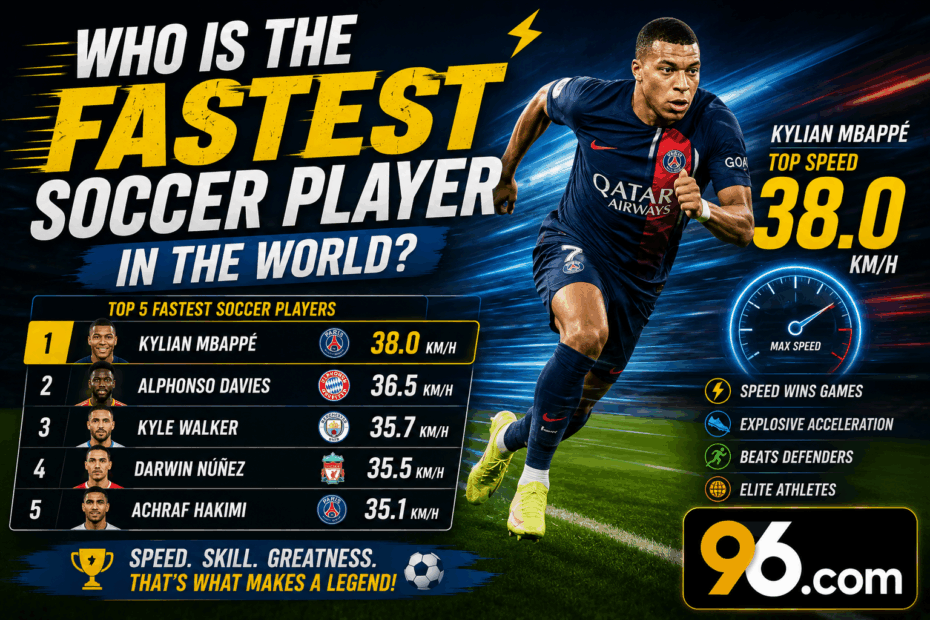
In modern football, raw pace is the ultimate cheat code. A single explosive burst can shatter a tactical defensive shape, turn a routine clearance into a lethal counterattack, and shift the live odds on premium platforms like 96 Bet. For fans who love tracking these athletic anomalies and engaging in soccer betting, knowing who holds the crown for the highest recorded speed is a major edge.
While legendary names like Kylian Mbappé always dominate the conversation, tracking data from the elite European leagues shows that a new generation of speedsters is taking over the pitch.
This guide breaks down the true kings of pace, how to get faster for soccer, and what it takes to survive in the fast lane of modern football.
What Makes a Soccer Player Truly Fast?
When you look at player props on the 96 APK app or watch a match unfold, you quickly realize that football speed is completely different from track-and-field speed. A sprinter runs in a straight line with zero obstacles. A football player must run while navigating shifting defenders, a moving ball, and unpredictable grass conditions.
Sprint Speed vs Match Speed
Straight-line velocity represents a player’s absolute peak ceiling. However, match speed is the ability to hit high-velocity markers repeatedly over 90 minutes while wearing heavy cleats and reading the game. A player might possess an elite top speed, but if they cannot combine it with sharp spatial awareness, that pace becomes ineffective in real match situations.
Acceleration and Agility in Football
In tight spaces, initial acceleration is far more dangerous than maximum top speed. The ability to go from a standstill to full speed within the first five meters leaves defenders stranded. Agility allows a player to maintain control while changing direction at high speeds, which is crucial for maneuvering out of tight high-press situations.
Why Speed Matters in Modern Soccer
Modern tactical systems rely heavily on a high defensive line and intense pressing. To beat these defensive blocks, teams use elite speed to:
- Exploit the open spaces left behind an aggressive, high-pressing opponent.
- Force opposition backlines to drop deeper, which opens up valuable space in the midfield.
- Recover defensively when a turn of possession leaves the backline exposed to a fast break.
Fastest Soccer Players Ever Recorded
The record books are constantly being rewritten as clubs prioritize sports science and athletic profiles. Let’s look at the absolute peak metrics recorded at the highest level of European competition.
Kylian Mbappé’s Top Speed
Kylian Mbappé has famously clocked a career-best peak of 38.00 km/h in previous campaigns with Paris Saint-Germain. While his recent domestic campaigns in La Liga registered around the 35.04 km/h to 35.70 km/h mark, his ability to combine that raw velocity with precise dribbling makes him a perennial favorite in football betting markets for top goalscorer.
Players Known for Explosive Pace
The current landscape features unbelievable athletes pushing past the 37.00 km/h barrier. Newcastle United’s Anthony Gordon turned heads by clocking a massive 37.92 km/h in elite European competitions, establishing himself as one of the most explosive wide players in the world.
Defenders and Wingers With Exceptional Speed
It is not just the attacking wingers hogging the spotlight. Tottenham Hotspur’s towering center-back Micky van de Ven stunned analysts by clocking 37.38 km/h, proving that defensive recovery pace can be just as elite. Meanwhile, Wolverhampton Wanderers wing-back Jackson Tchatchoua dominated the domestic charts by hitting a blistering 37.30 km/h.
How Player Speed Is Measured in Soccer
Gone are the days of scouts standing on the sidelines with manual stopwatches. Today, every single movement on the pitch is tracked with absolute military precision. It also raises questions as to what does full time mean in soccer, and how to understand it.
GPS Tracking Technology
Look closely at a player’s jersey and you will notice a small bulge between their shoulder blades. This houses a high-tech GPS tracker inside a specialized vest. These units capture thousands of data points per second, measuring total distance covered, high-intensity overloads, and exact top speeds.
Match Data and Sprint Statistics
Governing bodies and sports data firms use advanced optical tracking cameras installed around stadiums. These cameras sync with the ball and the players to verify electronic data, providing the official numbers you see highlighted during live broadcasts or on premier sportsbooks like 96.com.
Why Official Speed Numbers Change
A player’s top speed fluctuates based on several variables:
- Pitch Conditions: A wet, slick surface can increase slide velocity but can also limit firm traction.
- Game Situations: Players rarely hit peak speeds without a massive open patch of grass to chase into.
- Fatigue Levels: Sprints executed in the opening 10 minutes generally yield higher peak velocities than those in stoppage time.
Which Soccer Positions Need the Most Speed?
While every manager wants a dynamic squad, certain positions absolutely demand elite physical pace to function properly in modern tactical setups.
Wingers and Counterattacking Forwards
Wingers need elite pace to beat their markers on the outside and stretch the pitch. Counterattacking forwards use their speed to play on the shoulder of the last defender, waiting to break the offside trap during a rapid transition.
Full-Backs Tracking Fast Attacks
Modern full-backs are expected to fly up the flanks to overlap in attack, but they must also possess the recovery pace to chase down opposition wingers when possession flips. Without recovery speed, a team’s defensive flanks become highly vulnerable.
Goalkeepers and Reaction Speed
Goalkeepers rarely record high straight-line sprint speeds, but their short-area explosiveness is vital. A keeper needs exceptional footwork and lateral reaction speed to come off their line rapidly and sweep up loose long balls before an attacker arrives.
Can Players Become Faster for Soccer?
Genetics dictate a player’s baseline ratio of fast-twitch muscle fibers, but targeted athletic programming can optimize and significantly increase an athlete’s on-field velocity.
Sprint Training Techniques
Professional players work extensively on running mechanics, focusing on optimized stride length, precise foot placement, and proper arm drive to maximize energy efficiency during a sprint.
Strength and Explosive Power Workouts
To build explosive acceleration, players focus on lower-body power movements in the gym. Key exercises include:
- Heavy trap-bar deadlifts to build raw posterior chain strength.
- Plyometric box jumps and weighted sled pushes to maximize ground force production.
Recovery and Flexibility Importance
Muscles cannot produce maximum power if they are tight or fatigued. Elite clubs prioritize cryotherapy, deep-tissue massage, and targeted yoga routines to keep hamstring and calf muscles flexible, reducing injury risks during high-velocity movements.
Fastest Soccer Players Comparison Snapshot
To see how these elite athletes stack up, here is a detailed look at the top tier of raw speed in world football right now.
| Player | Top Recorded Speed | Playing Position | Club / League |
| Anthony Gordon | 37.92 km/h | Winger | Newcastle United (Premier League) |
| Micky van de Ven | 37.38 km/h | Center-Back | Tottenham Hotspur (Premier League) |
| Jackson Tchatchoua | 37.30 km/h | Wing-Back | Wolves (Premier League) |
| Gabriel Martinelli | 36.74 km/h | Winger | Arsenal (Premier League) |
| Bradley Barcola | 36.72 km/h | Winger | PSG (Ligue 1) |
Why Fans Love Fast Soccer Players
There is an undeniable electricity that goes through a stadium whenever a famously fast player gets isolated in space. It is one of the most thrilling sights in global sport.
Exciting Counterattacks
A classic counterattack can flip a defensive corner into a goal in less than ten seconds. Watching a team transition at breakneck speed keeps fans on the absolute edge of their seats.
One-on-One Dribbling Moments
When a speedy winger faces up against an isolated defender, the tension peaks. The pure simplicity of a player pushing the ball past an opponent and completely outrunning them is beautiful to watch.
Game-Changing Breakaway Runs
A brilliant breakaway run from the halfway line provides high-stakes drama. It creates a direct showdown between an attacker’s speed and a goalkeeper’s composure, defining the outcome of high-profile matches.
Conclusion
Velocity continues to dictate the tactical evolution of football. From the stunning recovery runs of center-backs to the devastating transitions of elite wide forwards, speed changes outcomes and influences live football markets globally. Download the 96 login, place your structured stakes, and keep a close eye on these incredible athletes as they continue to shatter speed records on the pitch.
FAQs
Who is officially the fastest soccer player in the world?
Recent tracking data shows Newcastle’s Anthony Gordon leading elite charts with an incredible peak of 37.92 km/h.
How fast can professional soccer players run?
Elite professional soccer players regularly clock top speeds between 34 km/h and 37.9 km/h during matches.
Why are wingers usually the fastest players?
Wingers require elite speed to stretch opposing defenses, beat full-backs wide, and drive rapid transitions.
Can soccer players train to become faster?
Yes, players increase speed through biomechanical sprint training, plyometrics, explosive strength workouts, and optimized recovery.
Is speed more important than skill in soccer?
No, speed is a massive weapon, but it must be paired with technical skill to be effective.
