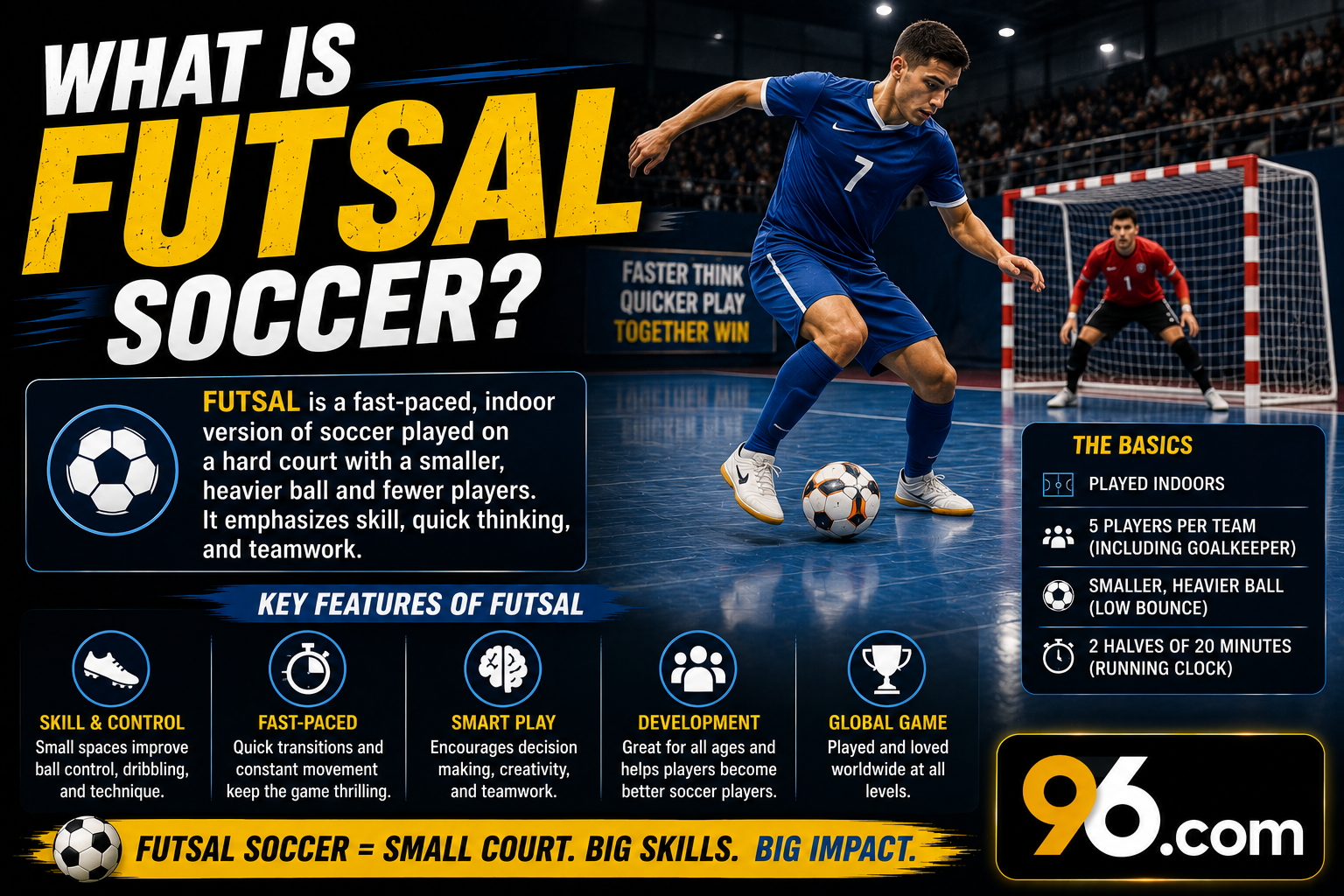
Football fans, today we’ll be talking about another fun topic! The topic we’re going to discuss is futsal. But before that, what is futsal soccer? So let us begin with futsal soccer, which is played indoors on a flat court with 5 players per team. This blog on 96.com provides information on what Futsal soccer is and how it’s played, along with the top football betting tips and other key strategies of the game.
How Futsal Is Different From Traditional Soccer
Traditional soccer is played outdoors on an open field, while Futsal soccer is played inside on a hard court.
Smaller Court and Fewer Players
| Traditional Soccer | Futsal Soccer |
| 11v11 format and on a large field. | 5 players per team, played on a basketball-sized court. |
| There are defined roles for attackers and defenders. | But in futsal, players have to act both as attackers and defenders because of the small space of the court and fewer players. |
Faster Gameplay and More Ball Touches
The size of the playing field forces the game to be faster, and players get much more time with the ball, compared to traditional soccer. Players have to make a lot of decisions on the go and change plans instantly.
Indoor vs Outdoor Playing Environment
- Playing on a smooth, hard court guarantees the same conditions year-round, and the movement of the ball becomes predictable.
- But soccer played on an open field doesn’t provide predictability. The weather changes constantly, and the ground can be uneven. Also, the playing area is huge compared to an indoor area.
Basic Rules of Futsal Explained
The rules for this are very different from traditional soccer. The team sizes are different and so are the match timings.
Match Duration and Team Size
Each team in Futsal has 5 players.
A match lasts for a total of 40 minutes with two 20-minute halves. Also, there is no stoppage time like outdoor soccer, and the half-time lasts for 10 to 15 minutes depending on the league.
Similarly, extra time is used only during the knockout matches.
Rolling Substitutions
There is no limit on substitutions; players can swap in and out of the game anytime they want, and the match doesn’t need to stop for it.
Fouls, Free Kicks, and Penalties
If players are involved in actions like tripping or pushing, it’s marked as a foul, and if they commit 5 fouls in one half, the other team gets a free kick for each foul.
Free kicks have to be taken in 4 seconds, and during it the players have to stand a minimum of 5 meters away.
Penalties are awarded for fouls inside the penalty box; they have to be taken from the 6-meter mark.
Why Many Young Players Start With Futsal
It’s good for kids because it keeps them involved and allows them to understand the game, as well as how to control the ball.
Better Ball Control Development
The ball makes it easier for kids to keep and control the ball. It also teaches them to use every part of their foot.
Improving Quick Passing Skills
Because you can’t just kick the ball and run after it like in traditional soccer, they learn how to make accurate, short passes.
Faster Decision-Making Under Pressure
Since there isn’t much space and opponents are always ready to take the ball away, young players have to learn how to make decisions in a few seconds by looking around and anticipating the next moves.
Futsal vs Soccer vs Other Small-Sided Games
It is very different compared to variations like bubble soccer or foosball. It’s an actual competitive variant of traditional soccer.
Difference Between Futsal and Bubble Soccer
Futsal soccer is a fast-paced competitive game played in teams of 5.
But what is bubble soccer? Bubble soccer is played wearing giant, inflatable plastic suits. The game is played for fun purposes only, as it becomes a hilarious turn of events when players bump into each other.
How Table Soccer Differs Completely
What is table soccer? Table soccer, or foosball, does not include any physical activity whatsoever. It’s a tabletop game: people control rows of plastic or wooden figures mounted on a rotating metal rod. All you need is fast hand reflexes, wrist control, and good timing.
Which Version Helps Technical Development More?
Futsal helps the most to develop skills because of how and where the game is played. Furthermore, you can also read and understand what GA mean in soccer and how it works while understanding Futsal vs Soccer.
Skills That Become Stronger Through Futsal
Players can develop skills like decision-making, game IQ and situational awareness. This is possible because of the nature of the game.
Dribbling in Tight Spaces
The small size of the court forces players into a lot of 1v1 challenges. It teaches them how to control the ball under pressure and learn other things like changing direction quickly.
First Touch and Close Control
Since the ball used is smaller and heavier and it doesn’t bounce much, it’s the best way for players to perfect their first touch.
Creativity and Movement
Players learn how to invent new shots and combinations to get past other players in such a small space.
Famous Soccer Players Who Played Futsal
Many famous soccer players have played futsal:
- Lionel Messi
- Ronaldinho
- Andrés Iniesta
- Pelé
Brazilian Legends and Their Futsal Background
Many Brazilian players have played the game and excelled at it. Players like Manoel Tobias and Falcão dominated the indoor game.
Falcão (Alessandro Rosa Vieira) was known as the Pelé of futsal. He holds the record for most goals in international men’s matches.
Schumacher (Flávio Sérgio Viana) was named the best Futsal player in the world in 2008, and played an important role in Brazil’s dominance during the 2000s.
How Futsal Helped Professional Careers
Because it is played indoors and the physical space is restricted, players develop quick thinking, mastering their dribbling skills, developing game awareness, and working with both their feet.
Is Futsal Growing Around the World?
This indoor version of soccer is growing around the world; as the world grows and there’s limited space outside, Futsal is gaining a lot of popularity.
School and Youth Competitions
This type of soccer requires quick decision-making and perfecting mastery over the ball; this is why schools and academies are making Futsal a part of their curriculum. It helps young children develop their skills.
Professional Futsal Leagues
Professional leagues are growing around the world, with club competitions like the UEFA Futsal Champions League having sponsorships and media rights. This makes this sport a legit career choice for many people.
Rising Popularity on Social Media
Because the game is fast-paced unlike traditional soccer, short-form videos of the game trend online. The fancy goals, quick footwork, and trick shots trend online, increasing the popularity of the sport.
Conclusion:
It’s not just an indoor version of soccer; it is a way for players to develop different skills and perfect their game. The lack of space leads to maximum ball contact, compelling players to develop good game awareness, problem-solving, etc. Make sure to keep following 96 bet for more football beting-related information, soccer betting and rewards.
FAQs
What is futsal soccer?
Futsal soccer is the indoor version of soccer. It’s a fast-paced game, and it’s played on a flat, hard court.
How is futsal different from regular soccer?
A smaller and heavier ball is used, which doesn’t have much of a bounce. It has shorter halves, and the clock stops when the ball goes out.
Is futsal played indoors?
Yes, futsal soccer is played indoors on smooth surfaces like a basketball court.
Why do soccer players train with futsal?
The lack of space helps players to develop footwork, decision-making, and perfect their passing game.
How many players are on a futsal team?
There are 5 players in each team, but there are no limits on substitutions.
